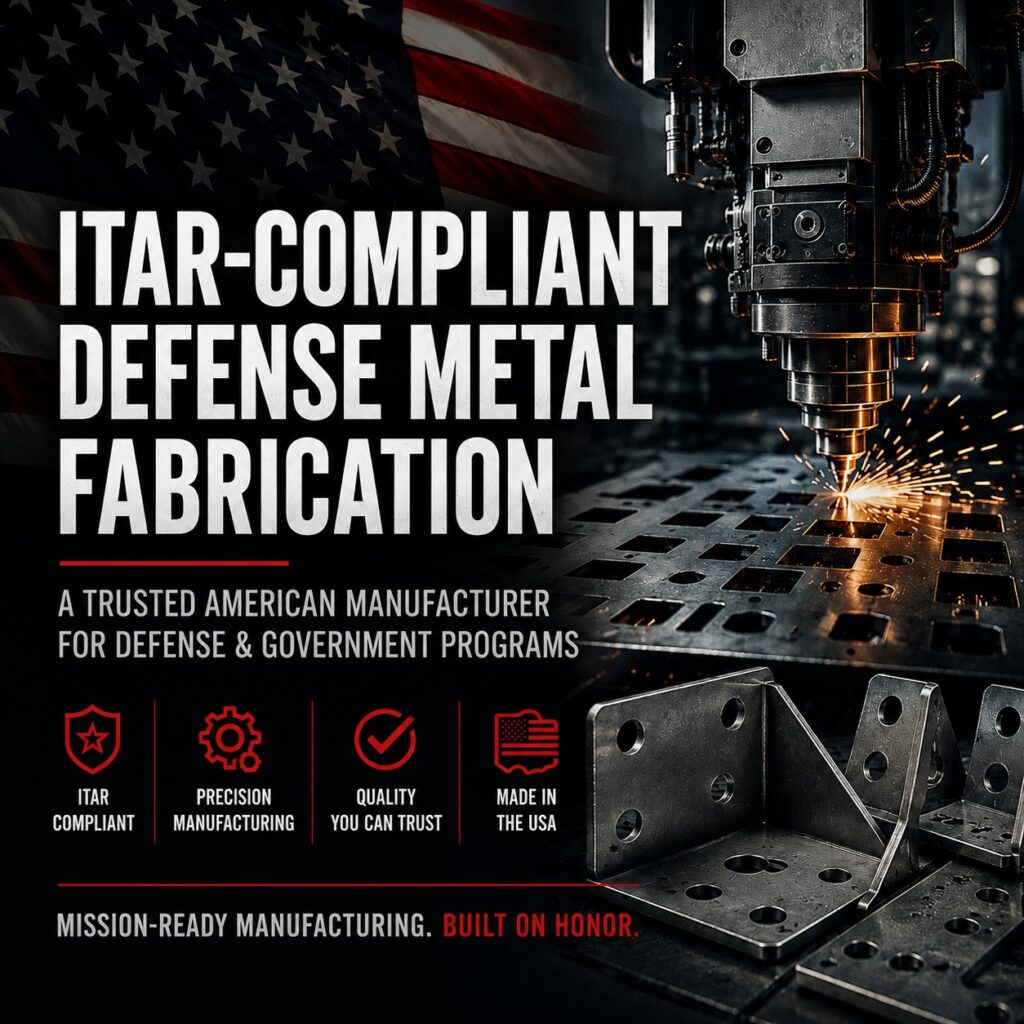
ITAR-Compliant Defense Metal Fabrication
A manufacturing resource for defense contractors, government suppliers, prime contractors, engineers and procurement teams requiring reliable U.S.-based metal manufacturing capability.
Defense Manufacturing Is a Supply-Chain Decision
Defense manufacturing requires more than the ability to cut, bend, weld and assemble metal.
Procurement teams, prime contractors, program managers and engineers need suppliers that understand controlled projects, documentation, repeatability, traceability, domestic production and the consequences of a disrupted supply chain.
A late bracket can delay an assembly. An inconsistent weldment can create an integration problem. A revision mistake can affect an entire production run.
That is why evaluating a defense manufacturing supplier goes far beyond checking whether the company owns the correct machine.
Metals of Honor approaches defense projects from this broader production perspective. The objective is not simply to fabricate a piece of metal. It is to manufacture the required component or assembly consistently and support the customer’s production requirements.
ITAR-Compliant Metal Fabrication in Florida
International Traffic in Arms Regulations requirements can affect how defense-related technical information and manufacturing projects are handled.
For buyers sourcing components associated with controlled defense programs, working with an ITAR-compliant domestic manufacturer helps establish an appropriate U.S. manufacturing environment for projects where ITAR requirements apply.
Metals of Honor operates from a 30,000-square-foot manufacturing facility in Lake Mary, Florida and supports defense-related manufacturing opportunities requiring fabricated components, weldments, subassemblies and finished assemblies.
Defense & Government Metal Components
MOH manufactures drawing-driven metal products rather than generic off-the-shelf military hardware. Production begins with the customer’s engineering requirements, drawings, specifications, quantities and required downstream operations.
Brackets & Mounting Hardware
Specialized brackets, mounting plates, reinforcement components, equipment supports and installation hardware manufactured to customer drawings.
Equipment Enclosures
Formed and welded components for electrical, electronic, communications, power and mechanical equipment enclosures.
Welded Assemblies
Multiple fabricated components joined into production-ready structures and assemblies within a coordinated manufacturing workflow.
Structural Supports
Manufactured supports for equipment installation, electrical systems, mechanical systems and infrastructure applications.
Panels & Plates
Laser-cut or punched mounting plates, access panels, base plates, covers and other flat or formed components.
Finished Assemblies
Projects can progress beyond fabrication into coordinated finishing, assembly, wiring, testing and final quality control where applicable.
From Drawing to Finished Assembly
Many manufactured components require several operations before they are ready for installation. When each operation is handled by a different supplier, the customer becomes responsible for coordinating the entire chain.
MOH’s turnkey manufacturing model is designed to reduce those supplier handoffs. Core manufacturing is performed through Metals of Honor’s production capabilities, while required finishing and coating operations can be coordinated through strategic partners.
Finished components can then move into applicable assembly, wiring, inspection and testing operations.
Fewer suppliers. Fewer handoffs. Clearer accountability. One manufacturing relationship.
Domestic Manufacturing for Defense Supply Chains
Defense supply chains place significant importance on domestic manufacturing capability.
A U.S.-based manufacturing source can provide advantages including easier supplier communication, shorter transportation routes, improved production visibility and reduced dependence on overseas manufacturing.
Metals of Honor manufactures in Lake Mary, Florida, providing defense contractors, government suppliers and OEMs with a domestic source for drawing-driven metal components and assemblies.
That becomes particularly important when a program moves beyond an initial component and into repeat production.
Production Capability Matters
A defense manufacturing supplier must be able to do more than produce the first acceptable component. The supplier must be able to reproduce it.
Laser Cutting
Precision profiles for drawing-specific sheet metal components.
CNC Punching
Efficient production of panels, plates and repeat features.
Metal Stamping
Production capability for suitable recurring metal components.
Precision Forming
Repeatable bends and formed geometries for production components.
Welding & Machining
Fabricated structures, weldments and machined component requirements.
Assembly & Testing
Downstream manufacturing support for more complete deliverables.
Manufacturing Controls Start With the Drawing
Defense procurement requires disciplined manufacturing controls. MOH evaluates projects against customer drawings, specifications, manufacturing requirements and applicable quality expectations.
Depending on the project, controls may address material requirements, drawing revisions, dimensional requirements, inspection, assembly verification, documentation, traceability and final testing.
Program-specific certification, documentation, inspection or traceability requirements should be identified during the RFQ process so they can be evaluated and incorporated into manufacturing planning.
Is Metals of Honor the Right Manufacturing Partner?
Drawing-Driven Components & Assemblies
MOH is particularly suited to customers seeking a U.S. manufacturer for recurring production parts, fabricated assemblies, welded components, cabinets, enclosures, mounting systems, equipment supports, stamped components and finished assemblies.
Manufacturing — Not Commodity Distribution
MOH is not positioned as a commodity metal distributor or supplier of generic off-the-shelf military hardware. The company’s focus is manufacturing customer-specific metal products and assemblies from engineering requirements, drawings and specifications.
Defense Manufacturing Questions
Is Metals of Honor ITAR compliant?
Yes. Metals of Honor is an ITAR-compliant U.S. metal manufacturer supporting defense-related manufacturing opportunities. Project-specific regulatory and contractual requirements should be identified during the RFQ process.
Where are MOH components manufactured?
Metals of Honor operates a 30,000-square-foot manufacturing facility in Lake Mary, Florida.
Can MOH manufacture parts from customer drawings?
Yes. MOH specializes in drawing-driven manufacturing of metal components and assemblies.
What defense components can MOH manufacture?
Potential products include brackets, mounting hardware, panels, plates, cabinets, enclosures, weldments, structural supports, equipment supports, fabricated components and mechanical assemblies.
Can MOH provide finished parts?
Yes. MOH can coordinate required finishing and coating operations through strategic partners as part of a turnkey manufacturing program.
Can MOH assemble components after fabrication?
Yes. Depending on the project, MOH can fabricate components and perform subsequent assembly, wiring, inspection and testing.
Does MOH work with defense prime contractors?
MOH can support prime contractors, subcontractors, OEMs, government suppliers and other organizations sourcing U.S.-manufactured metal components and assemblies.
Can MOH handle recurring production?
Yes. MOH’s manufacturing model is designed to support repeat production in addition to individual manufacturing projects. Quantities, forecasts and production requirements should be reviewed during quoting.
What should be included with a defense manufacturing RFQ?
Include available drawings, material specifications, quantities, tolerances, finishing requirements, inspection or documentation requirements, assembly needs and the target production schedule.
Need a U.S. Manufacturing Source for a Defense Component?
Send Metals of Honor the project requirements and let our team evaluate the complete manufacturing scope — not simply one isolated fabrication operation.
MOH can evaluate the manufacturing route, downstream operations and production requirements necessary to support the program.