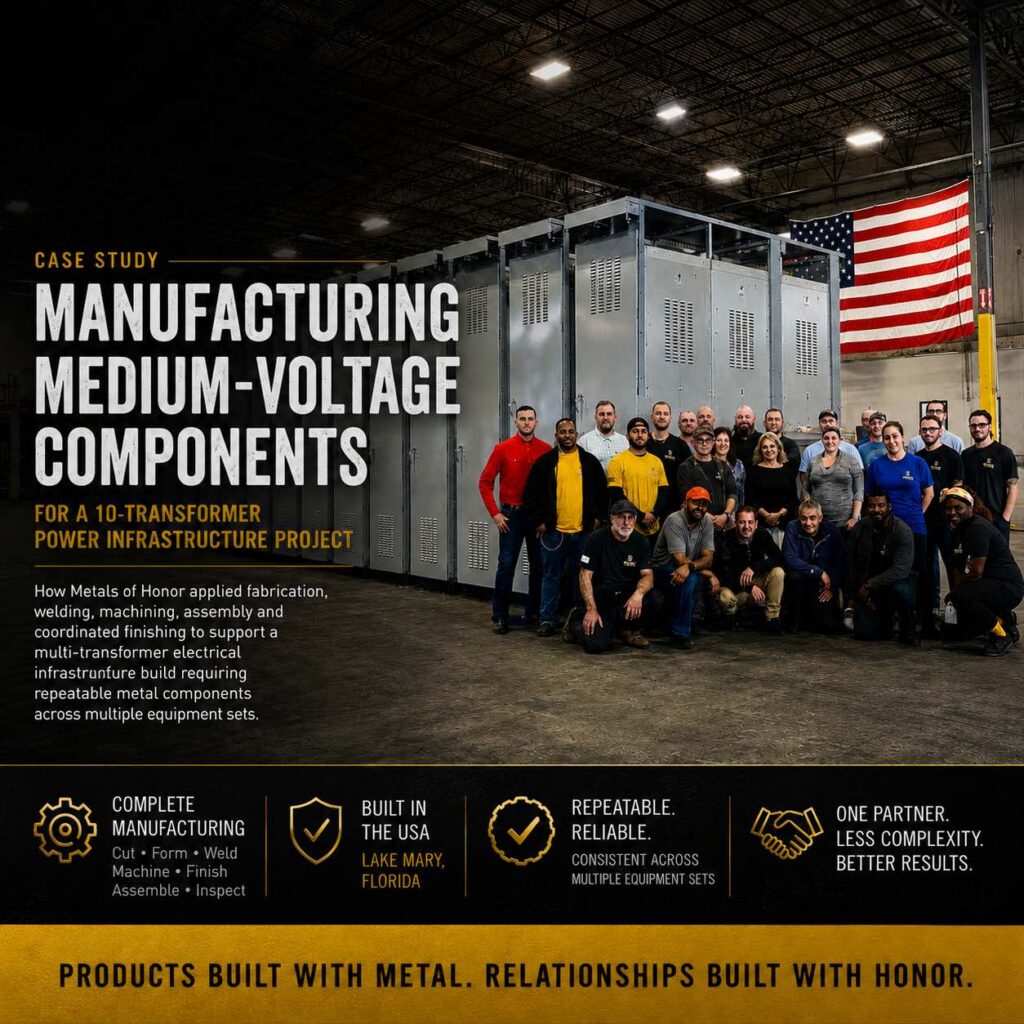
Manufacturing Medium-Voltage Components for a 10-Transformer Power Infrastructure Project
How Metals of Honor applied fabrication, welding, machining, assembly and coordinated finishing to support a multi-transformer electrical infrastructure build requiring repeatable metal components across multiple equipment sets.
The Challenge: One Project, Multiple Equipment Sets
Large power infrastructure projects rarely depend on one component. They require electrical equipment manufacturers, metal fabricators, finishing operations, logistics providers and installation teams to deliver the right components in the right sequence.
A project involving 10 transformers creates a substantially different manufacturing challenge than producing parts for one standalone unit.
A small manufacturing problem repeated across 10 equipment sets can become a major installation problem.
Quantities multiply. Production consistency matters more. Delivery sequencing becomes more important. A variation that appears minor on a single bracket can create fit-up or installation problems when repeated throughout the project.
Medium-Voltage Equipment Depends on Mechanical Precision
Electrical performance receives most of the attention on a medium-voltage project, but the mechanical hardware surrounding the system is equally important to successful assembly and installation.
Brackets must align. Supports must maintain geometry. Panels need correct hole locations. Weldments must interface properly with adjacent equipment.
When a design is deployed repeatedly across multiple transformer or equipment installations, dimensional consistency becomes a production requirement rather than a convenience.
Metals of Honor’s role is to manufacture these components according to the customer’s engineering drawings, specifications and project requirements.
Components Supporting Transformer & Medium-Voltage Infrastructure
Multi-transformer infrastructure projects can require numerous families of fabricated components rather than one repeated part. MOH’s manufacturing capabilities allow different component types to move through a coordinated production workflow.
Transformer Hardware
Fabricated and formed hardware providing mounting, structural, protective or installation functions around transformer equipment.
MV Hardware
Brackets, mounting plates, structural components, supports and related mechanical hardware for medium-voltage equipment.
Equipment Supports
Fabricated structures designed to position, support or secure electrical equipment within the installation.
Mounting Brackets
Drawing-driven brackets providing attachment points between equipment, structures and surrounding infrastructure.
Panels & Plates
Laser-cut or punched components incorporating holes, slots, cutouts and mounting features defined by engineering drawings.
Welded Assemblies
Multi-component structures manufactured and welded into larger equipment supports, bases, frames and assemblies.
Enclosure Components
Panels, covers, frames, bases and other fabricated parts supporting power-equipment enclosure systems.
Cable-Management Hardware
Brackets and supports used to route and support electrical cabling within larger infrastructure systems.
Finished Assemblies
Components progressing beyond fabrication into coordinated finishing, hardware installation, assembly and final inspection.
Treating the Project as a Production System
A multi-unit infrastructure project benefits from a manufacturing plan based on repeatability rather than treating every component as an isolated job.
Each stage affects the next. A dimensional issue during forming may not become obvious until welding. An incorrect hole location can create an installation problem. A finishing issue can interfere with later assembly.
Coordinating these operations through a defined manufacturing process helps prevent individual production problems from propagating downstream.
Laser Cutting & CNC Punching
Many sheet-metal components begin as flat profiles created through laser cutting or CNC punching.
Laser cutting provides flexibility for complex profiles, design changes and component families where dedicated tooling may not make sense. CNC punching can be effective for parts containing repeated holes, slots, knockouts and related features.
On a project with multiple families of components, access to more than one cutting process allows the manufacturing route to be selected around the specific part instead of forcing every part through one technology.
Forming for Repeatable Fit-Up
After flat components are produced, controlled bending creates the three-dimensional geometry required for mounting, enclosure construction, structural support and equipment installation.
Forming consistency becomes increasingly important as the same design is produced across several transformer or electrical equipment sets.
A bend that is slightly wrong once is a rework issue. A bend that is slightly wrong across an entire project becomes a production issue.
Maintaining the forming operation within the broader manufacturing workflow allows dimensional requirements to be managed before parts progress into welding, finishing or final assembly.
Welding Adds Another Level of Production Control
Welded medium-voltage and transformer-support components require more than joining two pieces of metal.
Individual components must be positioned and welded while maintaining the required final geometry so the assembly will properly interface with surrounding equipment.
By combining fabrication and welding within the same manufacturing relationship, MOH can produce both the individual components and the resulting weldment.
Potential applications include equipment frames, bases, mounting structures, enclosure assemblies and structural supports.
Extending the Workflow Beyond Raw Fabrication
Electrical infrastructure components often require additional finishing, coating, hardware installation or assembly before they are ready for the customer’s production line or installation site.
Manufacture → Finish → Return
MOH can coordinate appropriate coating and finishing requirements through strategic partners rather than requiring the customer to manage each outside operation independently.
Inspect → Assemble → Deliver
Where applicable, finished components can return to MOH for hardware installation, mechanical assembly, wiring, final inspection or other downstream manufacturing requirements.
The customer receives a more complete manufactured product instead of coordinating every individual operation.
Quality Control Across Multiple Equipment Sets
A 10-transformer project amplifies the importance of consistency.
If each transformer installation requires multiple fabricated brackets, plates, supports or assemblies, those requirements multiply quickly across the overall project.
Quality control therefore has to evaluate both the individual component and the consistency of the overall production run.
Exact inspection, documentation and traceability requirements should be identified during project planning so they can be evaluated as part of the manufacturing process.
The Value of One Manufacturing Partner
Consider a project where one company cuts the components, another bends them, a third performs welding, a fourth applies the finish and the customer performs the final assembly.
That structure can work, but it places the coordination burden on the customer.
Every additional supplier creates another production schedule, purchase order, transportation step, quality handoff and potential source of delay.
Metals of Honor’s turnkey approach is designed to reduce those handoffs and create a single point of manufacturing accountability across a larger portion of the production process.
Why This Manufacturing Model Matters for Data Centers
The same manufacturing strategy used for multi-transformer electrical infrastructure directly applies to the rapidly expanding data center market.
Modern data centers depend on transformers, medium-voltage equipment, switchgear, power distribution systems, backup power and other critical infrastructure long before electricity reaches a server rack.
As data center campuses grow in power density and physical scale, the manufacturing supply chain supporting that infrastructure must scale with them.
Brackets, formed hardware, mounting components and structural parts used around transformer equipment.
Fabricated components supporting MV distribution and control equipment.
Panels, supports, brackets, frames and mounting hardware.
Cabinets, panels, covers and structural enclosure components.
Drawing-specific mechanical support hardware associated with electrical distribution systems.
Brackets and supports associated with high-density power routing.
Fabricated and welded structures supporting equipment installation.
More complete manufactured deliverables that combine fabrication, finishing coordination, assembly and inspection.
From One Installation to a Repeatable Program
The 10-transformer project demonstrates an important manufacturing principle: infrastructure growth requires repeatable production.
Producing one successful component proves basic capability.
Establishing a manufacturing process that can support multiple equipment sets demonstrates something more valuable to an OEM or procurement team: the ability to support a program.
The conversation shifts from “Can you make this part?” to “Can you reliably support this production program?”
That is the type of manufacturing relationship Metals of Honor is positioned to build with transformer manufacturers, medium-voltage equipment OEMs, power-distribution suppliers and data center critical-power companies.
Multi-Transformer Project Manufacturing Questions
Can Metals of Honor manufacture components for multi-transformer projects?
Yes. MOH can evaluate production requirements involving multiple equipment sets, component families and recurring quantities rather than only one-off fabricated parts.
Does MOH manufacture complete transformers?
MOH’s role is metal manufacturing. The company manufactures drawing-specific metal components and assemblies that can support transformer, medium-voltage, switchgear and other power-infrastructure equipment.
What manufacturing processes can be used on a project like this?
Depending on the component requirements, manufacturing can include laser cutting, CNC punching, stamping, bending, machining, welding, assembly, testing and quality control.
Can MOH coordinate powder coating or other finishing?
Yes. MOH can coordinate appropriate finishing and coating operations through strategic partners as part of a turnkey manufacturing program.
Can finished components return to MOH for assembly?
Yes. Where appropriate, finished components can return to MOH for hardware installation, mechanical assembly, wiring, inspection or other downstream manufacturing operations.
Can MOH support medium-voltage equipment manufacturers?
Yes. MOH can manufacture drawing-driven metal hardware and assemblies for medium-voltage applications when the project fits its production capabilities and requirements.
How does MOH support repeatability across multiple equipment sets?
Repeatability starts with controlled drawings, process planning and manufacturing consistency across cutting, forming, welding, finishing coordination, assembly and inspection.
Why consolidate multiple manufacturing processes with one supplier?
Consolidation can reduce vendor management, transportation between suppliers, production handoffs and ambiguity over responsibility when issues arise.
Does this type of manufacturing apply to data center projects?
Yes. Data center critical-power infrastructure requires transformers, medium-voltage equipment, switchgear and related electrical systems, all of which depend on supporting fabricated metal components, hardware and assemblies.
What should a buyer include with an RFQ?
Include available drawings, material specifications, quantities, tolerances, finishing requirements, expected production schedules, inspection requirements and any assembly or testing needs.
Planning a Transformer, Medium-Voltage or Critical-Power Project?
If your organization is manufacturing transformers, switchgear, medium-voltage equipment, power-distribution systems or data center critical-power infrastructure, Metals of Honor can evaluate the metal manufacturing requirements supporting the project.
For larger programs, include anticipated future quantities so MOH can evaluate the manufacturing approach not only for the first order, but for repeat production.
The goal is to establish a manufacturing process capable of supporting the project as equipment quantities and infrastructure requirements scale.